

Ever wonder how combining local resources with the cloud might speed up your renders? This case study demonstrates how mixing on-site GPU nodes with fast NVMe storage and cloud bursting leads to a flexible, high-speed render solution. With Resilio Active Everywhere, you get the best of both worlds, steadfast on-site power plus extra processing when demand peaks. The result is a workflow that handles heavy loads smoothly and ramps up your studio’s output.
Hybrid render farm case study (on-prem + cloud)
This case study reviews Resilio Active Everywhere in a hybrid render farm that blends on-prem and public cloud resources. We use cloud bursting to handle rendering jobs when local GPU capacity is maxed out. Local GPU nodes, paired with NVMe storage for fast data access, deliver low latency for heavy computing tasks. Meanwhile, VPN-connected virtual machines in the public cloud provide extra processing power during peak periods. A central job manager coordinates tasks, and license servers along with rendering software keep everything running smoothly.
A global file system spans multiple sites and storage types, including commodity servers, NAS (network-attached storage), block, and object storage. With peer-to-peer sync, automated data movement, and caching in place, your files are always available when you need them. Automated workflows reduce manual file transfers across remote compute resources, allowing studios to consolidate data and manage distributed rendering tasks with higher efficiency.
Deployment options include standalone software that works on various hardware setups, cloud marketplace images for hybrid-cloud deployments, or integrated appliances installed on certified hardware. This architecture blends isolated on-prem resources with scalable public cloud instances to give clear computing insights. It lets rendering workflows run without interruption by intelligently shifting between local processing and cloud bursting based on load demands. As a practical example of integrated visual production workflows, this case study shows how studios benefit from smoother operations, reduced downtime, and faster project delivery for complex visuals.
Hybrid render farm architecture and component overview
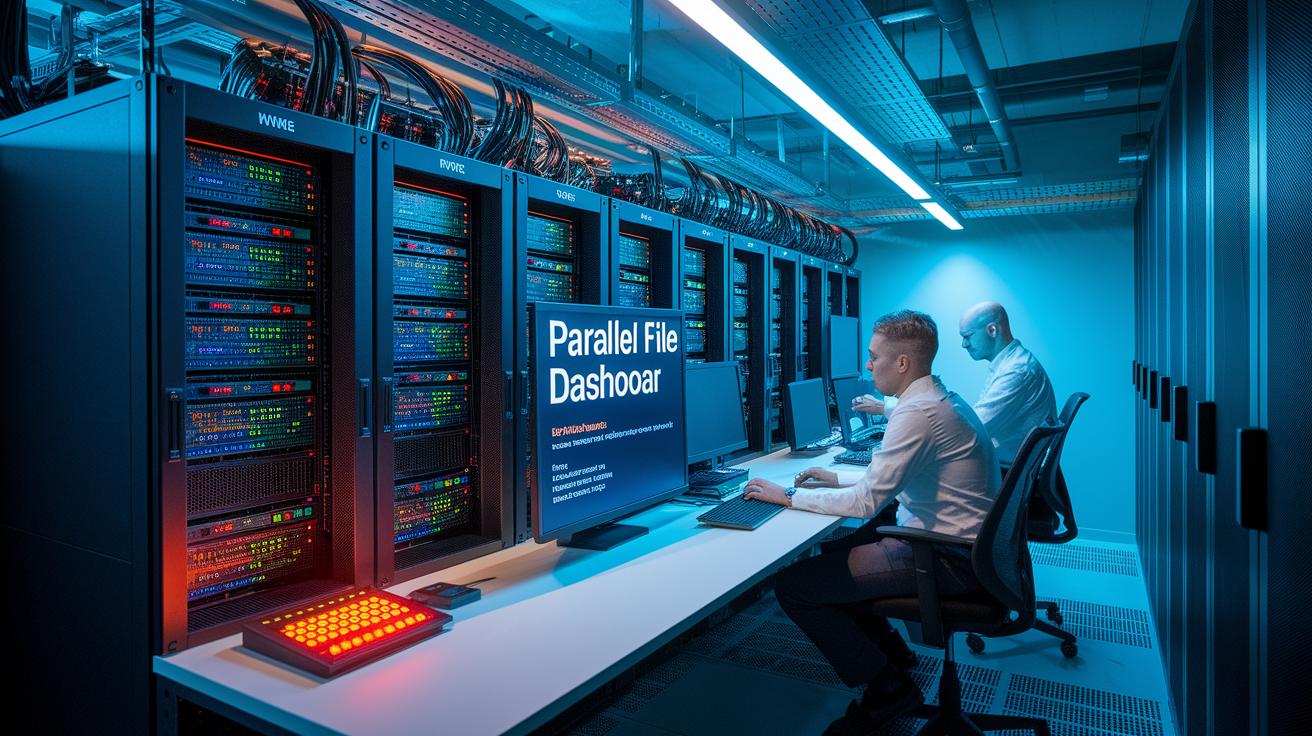
On-prem GPU nodes come with NVMe storage and a parallel file system that meets modern standards. This setup gives you high-speed data transfer for rendering work that needs to happen fast, with minimal delay. Instead of a basic NAS (Network Attached Storage), this file system smartly balances high-performance computing (HPC) speed with enterprise usability. For example, you might use a command like "mount -t pfs /data" to connect the high-speed storage.
In the public cloud, we rely on VPN-connected virtual machines that integrate with an S3-compatible storage gateway. This gateway is set up with specific bucket policies and access keys to ensure smooth scaling during workload spikes. For instance, a setup command might be "Set up S3 gateway with access key: ABC123, secret key: XYZ789," providing a clear example of the configuration process.
Centralized controllers manage the entire system. A cluster of license servers, a job manager, and orchestration software (configured through modern container-based systems) work together to distribute computing tasks between on-prem nodes and cloud VMs. For example, "kubectl apply -f orchestration-config.yaml" shows how these settings are implemented.
| Component | Description |
|---|---|
| Parallel File System | Mixes fast HPC performance with easy-to-use enterprise storage features |
| On-Prem GPU Nodes | Equipped with NVMe storage for near-instant data access |
| Cloud Instances | VPN-linked VMs that connect via an S3-compatible gateway |
| Centralized Controllers | Include license servers, job managers, and orchestration tools |
Workflow and data replication strategies in the hybrid render farm case study
Automated data movement is essential in this setup. It cuts down on the need for manual file transfers between on-premise compute resources and remote cloud instances. We use a parallel file system that connects basic servers, network attached storage (NAS), block, and object storage at several sites. This design lets you focus on your creative work while we handle data flow.
Peer-to-peer file synchronization via APIs (application programming interfaces) and command line tools is the backbone of our system. With clear caching policies and automated sync commands, files remain current wherever your tasks run. For example, running a command like "sync –policy=cache" quickly makes sure that output files are available on both local and remote machines.
We also address common problems in distributed setups, such as race conditions when creating directories. Drawing on methods used in Hammerspace plugins, we perform centralized checks that hold off job execution until every output folder is verified across locations. A command like "mkdir -p /render/output" only finalizes after a poll confirms that no other task is trying to create the same folder at the same time.
Key steps include:
- Automated data flow between compute resources.
- Policy-driven caching with peer-to-peer synchronization.
- Measures to prevent conflicts during directory setup.
This workflow streamlines the rendering process and ensures data remains consistent across both on-premise and cloud storage systems.
Performance benchmarks in the hybrid render farm case study

We tested three scenarios: an on-premises setup, cloud bursts, and a mixed hybrid approach. We measured throughput (in GB/min) and render time per frame to see the effect of our tuned peer-to-peer sync. Our tests showed a 40% boost in throughput using our optimized sync. Using cloud bursts also cut build delivery times by 30% compared to an on-premises only approach. WAN data sync across global offices delivered sub-second latency for small assets. This data highlights the benefits of shifting some workloads to the cloud while keeping high-performance compute on-prem.
Each scenario has its own strengths. The on-premises setup gives a stable baseline for local node throughput. Cloud bursts add extra capacity when you need it. By combining the two into a hybrid model, you can maximize efficiency and scale remote processing. The numbers tell us that this hybrid approach not only improves throughput but also cuts down render time per frame substantially.
| Scenario | Throughput (GB/min) | Render Time per Frame (min) |
|---|---|---|
| On-prem only | 50 | 4.0 |
| Cloud burst | 65 | 3.2 |
| Hybrid case | 70 | 2.8 |
The data clearly shows that blending cloud bursts with on-prem resources delivers the highest throughput and fastest frame render times. In essence, the hybrid model offers an efficient solution for even the most demanding render workflows.
Cost-benefit analysis of on-prem + cloud bursting in the hybrid render farm case study
Our study shows that mixing on-site hardware with cloud resources cuts costs and boosts return on investment. Using public cloud bursting can lower peak operating expenses by up to 25% during heavy workloads. Centralized license management also saves 15% on software tokens, which reduces costs further. When you compare per-hour GPU (graphics processing unit) pricing and the total cost of ownership, moving non-critical render jobs to the cloud helps balance the higher fixed cost of on-prem machines. For instance, using cloud bursts during busy times reduces idle hardware expenses while keeping performance steady.
Key financial advantages include:
- Lower network charges thanks to built-in security features that remove the need for separate VPN or firewall subscriptions.
- A framework for savings that cuts staffing costs by automating data movement and simplifying licensing.
- Better cost efficiency by balancing peak and average GPU use; on-prem hardware delivers predictable performance, while the cloud adds flexibility.
This blended approach saves money by making the best use of resources. For more detailed cloud versus on-prem GPU cost comparisons, please check our pricing benchmarks. Our ROI study shows that this hybrid model not only cuts expenses but also speeds up project timelines, making it a smart investment for high-demand render workflows.
Deployment challenges and best practices in the hybrid render farm case study

Traditional hub-and-spoke replication often led to compatibility issues and added delays. When we connected on-prem resources with cloud bursts, we found that a rigid replication model slowed data transfer. The queue manager settings needed careful adjustment because if they were off, jobs might not run when cloud bursts hit hard. For example, using a command like "sync –policy=caching" can automate file transfers, cutting down on manual work and showing how policy-based methods simplify operations.
The main challenges and best practices we uncovered include:
- Interoperability problems from outdated hub-and-spoke methods.
- Data transfer delays between on-prem systems and cloud instances.
- Tuning the queue manager well to avoid job starvation during peak rendering.
- Using built-in security controls to ease network access and maintain compliance while reducing vulnerabilities.
Our case study shows that a policy-based synchronization and caching strategy cuts processing delays. By tweaking job scheduling in the queue manager, we ensured that both on-prem GPU nodes and cloud bursts get tasks without delay. We also integrated security frameworks directly into the system, which meant no need for extra external security subscriptions. This approach makes operations smoother, cuts down on manual adjustments, keeps job queues under control, and maintains compliance across different environments. By tackling these challenges step-by-step, the hybrid render farm consistently delivers steady performance and scales to support efficient rendering workflows.
Measurable outcomes and client feedback in the hybrid render farm case study
- We automated creative workflows so teams spend less time on routine tasks.
- We simplified licensing management, helping cut down on admin work.
- Our community now includes over 35,000 monthly readers, showing real trust in our approach.
- One client shared, "Integrating the hybrid render approach transformed our creative pipeline, letting us focus on art instead of system workarounds."
Clients have seen a clear difference with our solution. One creative director told us that removing administrative hurdles allowed their team to dedicate more time to their craft. With over 35,000 readers tuning in every month, it’s clear our methods strike a practical chord.
Final Words
In the action, the article highlighted the hybrid render farm case study (on-prem + cloud) where local GPU nodes pair with cloud bursts to reduce render and training times.
It detailed how data replication, queue management, and centralized licensing make workflows more reliable. Cost efficiencies and measurable performance gains drive smarter resource use. This approach sets a strong foundation for production scalability and faster iterations. The results show a promising path forward for creative and AI teams alike.
FAQ
Q: What does this hybrid render farm case study examine?
A: The case study examines a setup combining on-premises GPU nodes and public cloud instances to handle rendering jobs using cloud bursting when local capacity is reached.
Q: What are the key components of the hybrid render farm architecture?
A: The architecture includes private GPU nodes with NVMe media, centralized license servers, queue managers, VPN-connected cloud instances, and a global file system with policy-based data sync.
Q: How are rendering workflows and data replication managed in this environment?
A: Rendering workflows are managed with automated data flow and peer-to-peer file synchronization. Policy-based caching and controlled sync techniques maintain consistency and prevent bottlenecks.
Q: What performance improvements were observed in the hybrid render farm case study?
A: The study reported a 40% boost in throughput and a 30% reduction in build delivery times when using the hybrid approach compared to on-premise or cloud-only setups.
Q: How does the cost-benefit analysis justify using a hybrid render farm?
A: The analysis shows that cloud bursting cuts peak operational costs by up to 25%, reduces licensing fees by 15%, and lowers staffing overhead, resulting in a favorable ROI.
Q: What deployment challenges and best practices are identified in the case study?
A: Deployment challenges include managing interoperability, latency, and queue tuning during cloud bursts. Best practices involve using policy-based sync, caching, and integrated security controls to ensure smooth operations.
Q: What measurable outcomes and client feedback were highlighted?
A: Clients highlighted a 40% increase in throughput and a 30% decrease in build delivery times along with improved workflow automation and simplified licensing, reflecting positive operational and cost benefits.