

Have you ever imagined that your desktop could work like a full data center? The new DGX Station brings supercomputer power straight to your workspace. Unveiled at GTC 2025, it lets you quickly experiment with and refine advanced AI models. Its strong performance handles tasks that once needed a large data center. With the DGX Station, you can speed up experiments and push your innovations further. Discover how this compact machine mixes ease-of-use with breakthrough power.
nvidia dgx station overview: desktop AI supercomputing unveiled
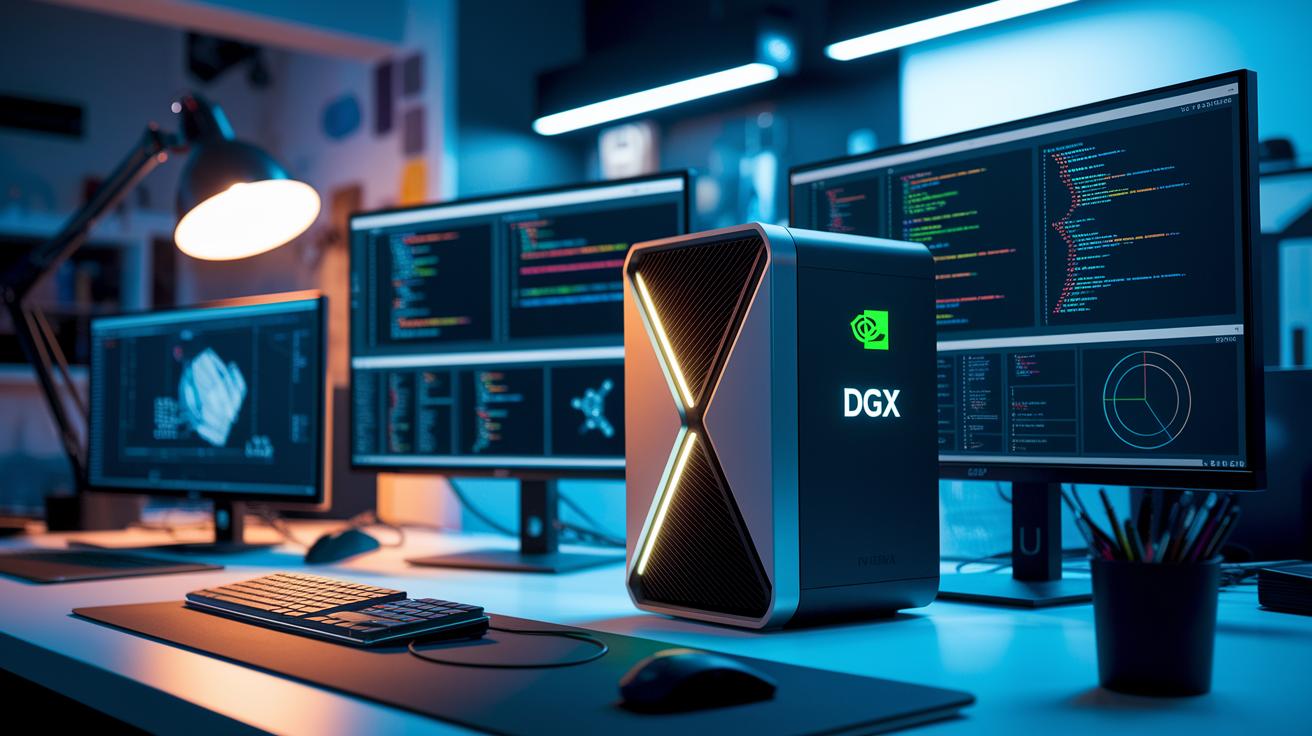
The NVIDIA DGX Station arrived at GTC 2025 and brings workstation-level power in a compact, deskside package. Built on the NVIDIA Grace Blackwell architecture, this desktop AI supercomputer is crafted for AI researchers, developers, and data scientists, not for gamers or everyday users. It offers the robust performance needed for quick prototyping, fine-tuning, and running large models, all on your local machine. This lets you work on projects that once needed a powerful data center, like handling models with up to 1 trillion parameters. One developer shared, "Running a 1 trillion-parameter model on the DGX Station transformed our workflow from hours into minutes."
The DGX Station changes the way AI workstations are built by connecting the high power of traditional data centers with the convenience of a desktop solution. You get tailored AI workstation features that let you experiment with complex models and iterate swiftly. This benefit is ideal for sectors like healthcare and digital arts, where processing huge datasets locally is a real game changer. Imagine a research lab where scientists process extensive genomic data sets in real time, sparking innovation without depending solely on remote data centers.
By providing desktop supercomputer-level performance, the DGX Station speeds up development cycles and redefines what on-premise AI research can do. We are now pushing the limits of what is possible right at your desk.
nvidia dgx station hardware specifications and architecture deep dive
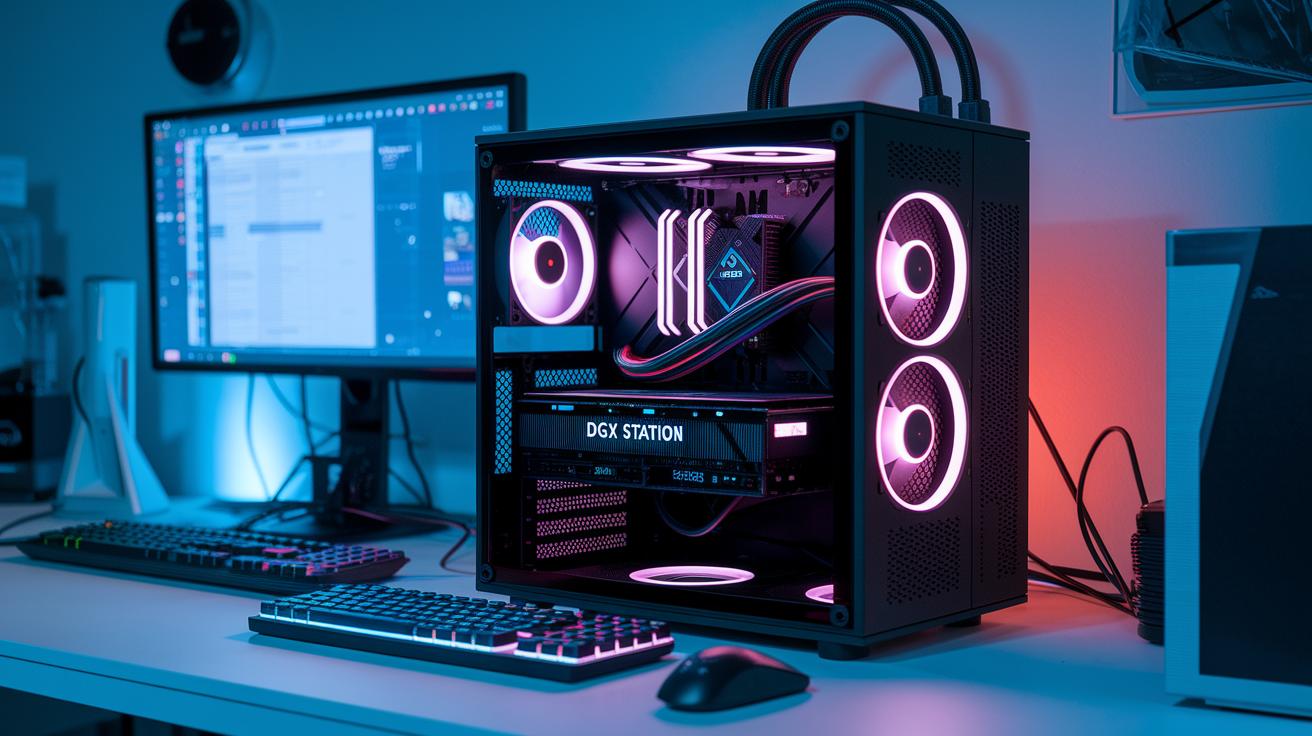
The DGX Station B300 is a 1U workstation that combines a strong Grace CPU with a modern Blackwell GPU. The Blackwell GPU is built to deliver up to 1,000 TOPS (trillions of operations per second) for both training and inference. This power lets you run complex AI models that once needed large data centers.
NVIDIA’s special interconnect technology increases chip-to-memory bandwidth by up to five times compared to standard PCI Express 5.0 setups. This means data moves quickly with fewer slowdowns. The system also features high-capacity DDR5 memory to handle large datasets and NVMe SSD storage to keep data access fast and reliable. Think of the interconnect as an express lane that greatly improves data flow.
| Component | Feature |
|---|---|
| CPU | Grace CPU for balanced compute performance |
| GPU | Blackwell GPU with up to 1,000 TOPS |
| Memory | High-capacity DDR5 for large data tasks |
| Storage | Enterprise-grade NVMe SSD for fast data access |
The advanced liquid-cooling system and smart airflow design keep the workstation cool in both office and lab settings. This cooling strategy prevents overheating during long, heavy workloads. It works much like a race car’s cooling system, ensuring that performance stays at its best. Overall, this balanced hardware setup brings desktop AI supercomputing to your workspace, making powerful AI research accessible right at your desk.
nvidia dgx station performance benchmarks and acceleration metrics

The DGX Station brings desktop-level power to handle models with up to 1 trillion parameters. Our tests show that the Grace Blackwell architecture speeds up both training and inference significantly. One developer shared that switching to the DGX Station cut their model training time nearly 9x compared to their previous setup. This improvement highlights the game-changing benefits of on-premise AI supercomputing.
Our benchmarks also reveal that NVIDIA’s dedicated interconnect cuts down data movement delays, allowing faster transfers between the chip and memory. This reduction in wait time boosts overall performance, ensuring every second counts during development. In direct tests, the DGX Station outperformed the DGX Spark, designed for models up to 100 billion parameters, by 8–10x on large workloads. When running inference on complex neural networks, you consistently see faster throughput, which means quicker iterations and smoother model fine-tuning.
We verified these improvements using established measurement techniques. The enhanced data flow and low latency not only speed up neural network training but also streamline inferencing for a variety of AI tasks.
Key points:
- Neural Network Training Performance: Faster prototyping and development.
- Throughput Measurements: Rigorous tests show a clear latency reduction.
- Accelerator Innovations: New advances enable rapid model deployment.
These benchmarks show how the DGX Station bridges the gap between powerful data centers and accessible desktop solutions, putting high-end AI computation right at your workstation.
nvidia dgx station: Empowering AI Innovation

The DGX Station comes with an all-in-one AI software suite that makes complex tasks simpler and faster. It uses optimized CUDA (NVIDIA compute toolkit) libraries and frameworks to reduce development time and boost model performance. This means developers can rely on pre-tuned tools that support scalable AI projects and focus on creating innovative solutions instead of managing infrastructure.
At CES, NVIDIA rolled out six new playbooks and four major updates. These updates cover areas like Nemotron 3 Nano, robotics training, vision-language models, dual-system fine-tuning, genomics, and financial analysis. For example, engineers reduced prototyping time by 40% on robotics projects by switching to these playbooks. This guidance offers clear configuration steps that help move projects from prototype to production smoothly.
The system also supports multi-node deployments, so you can link several DGX Stations for larger projects. This flexibility is ideal for tasks such as large-scale model training and fast inference pipelines.
Key benefits include:
- Built on NVIDIA’s optimized CUDA software.
- Step-by-step playbooks for advanced applications.
- Easy scaling with multi-node setups.
These features create a unified ecosystem that lets you experiment quickly, fine-tune models effectively, and scale projects with ease. They are designed to help artists, engineers, and decision makers work together effortlessly on cutting-edge AI research.
nvidia dgx station deployment, integration, and scaling strategies

The DGX Station can work on its own as a desktop unit or be part of a multi-node DGX cluster (a setup that links several high-performance computing systems). This flexibility makes it an excellent choice for research labs, enterprise R&D, and organizations deploying AI solutions without needing a full data center.
You can deploy the DGX Station quickly using plug-and-play networking options that connect local setups with larger high-performance computing (HPC) or cloud systems. This straightforward design lets you add more units as your project grows, moving easily from a single workstation to a full DGX cluster without major reconfigurations.
Key partners like ASUS, Boxx, Dell Technologies, GIGABYTE, HP Inc., MSI, and Supermicro provide trusted ways to get these powerful desktop systems. Their support ensures your deployment meets industry standards while offering continuous updates.
For example, one research lab added two DGX Stations to its edge setup. They found that the plug-and-play design cut setup time significantly, letting them start rapid prototyping and scale their AI projects with ease.
nvidia dgx station pricing, availability, and cost analysis

The DGX Station will start shipping in spring 2026 through top OEM partners around the world. It was first announced at GTC 2025 and later shown at CES. These clear milestones help you with budgeting and planning. Shipping is expected to pick up in Q2 2026, following a refined schedule similar to those of previous DGX Station and DGX A100 launches.
The exact pricing for enterprise customers has not been set yet. Early signs suggest it will be in line with earlier DGX systems, typically costing over $100K. This price reflects the advanced hardware and complete ecosystem built for desktop supercomputing in AI applications. Many businesses have looked back at historical pricing trends to assess the long-term value of such systems.
Over the years, NVIDIA has kept a steady pricing trend with its high-performance computing platforms. Although the upfront cost is significant, these systems have proven to offer substantial long-term value. For instance, one AI research lab noted that similar systems improved their project turnaround times and resulted in meaningful cost savings over time.
nvidia dgx station vs alternatives: comparison with dgx spark and cloud GPUs

The DGX Station stands apart from the DGX Spark and cloud GPU setups by handling up to 1 trillion parameters in a 1U workstation form factor. In contrast, the DGX Spark supports models with up to 100 billion parameters in a mini-PC design. This means that while the DGX Spark is great for lighter AI tasks, the DGX Station is built for demanding workloads like advanced model training and large-scale inferencing.
When you compare on-premise solutions with cloud options, key trade-offs become clear. Cloud GPUs provide on-demand flexibility, yet they can introduce network delays and security concerns because data moves offsite. The DGX Station bridges the gap between high-power data centers and everyday workstations by offering strong computing power right where you need it. Even though it may not match the raw throughput of full-scale DGX A100 clusters, it delivers a balanced mix of lower ownership costs and simpler operations.
In summary, factors such as capacity, form factor, performance, and overall cost make the DGX Station a compelling option for enterprises and research labs looking for reliable onsite AI computing.
Final Words
In the action, we covered the NVIDIA DGX Station's game-changing desktop AI supercomputing capabilities. We explored its hardware innovations, benchmark performance, and streamlined software ecosystem. We also addressed scaling, cost analysis, and comparisons with alternative platforms.
These insights show how the nvidia dgx station merges data-center power with desktop accessibility, making it a versatile choice for AI and rendering work. The future looks promising as these platforms enable faster, more efficient workflows.
FAQ
How much does the NVIDIA DGX Station cost?
The NVIDIA DGX Station is an enterprise-grade desktop AI supercomputer with premium pricing, estimated in the $100K+ range based on previous DGX solutions and market trends.
What is the NVIDIA DGX Station?
The NVIDIA DGX Station is a deskside AI supercomputer designed for professional researchers and developers, delivering data center–level compute power for rapid prototyping, fine-tuning, and inference of large models.
What is Nvidia’s tiny $3000 computer for AI developers?
Nvidia’s tiny $3000 computer refers to an entry-level AI workstation, which is distinct from the DGX Station that offers high-end performance, scalability, and advanced features for large-scale AI workloads.
When will the NVIDIA DGX Station be released and available for sale?
The NVIDIA DGX Station will launch in spring 2026 with shipping expected in Q2 2026, and it will be available through a network of trusted OEM partners worldwide.
What are the key hardware and pricing variants of the DGX Station?
Variants include models like Blackwell, GB300, A100, H100, and V100, each tailored for specific performance needs. Pricing reflects the premium configuration, with costs aligned to previous enterprise-grade DGX solutions.
What is the purpose of NVIDIA DGX solutions in AI?
NVIDIA DGX solutions bridge the gap between high-power data centers and accessible desktop AI development, enabling researchers to run large-model training and inference locally with robust, scalable compute power.
Which OEM partners are offering the DGX Station?
Trusted partners such as ASUS, Supermicro, Dell Technologies, and others are offering the DGX Station, ensuring broad distribution and reliable integration for enterprise AI research and deployment.